
Amazon FBA Mistakes to Avoid If You Want to Stay Profitable
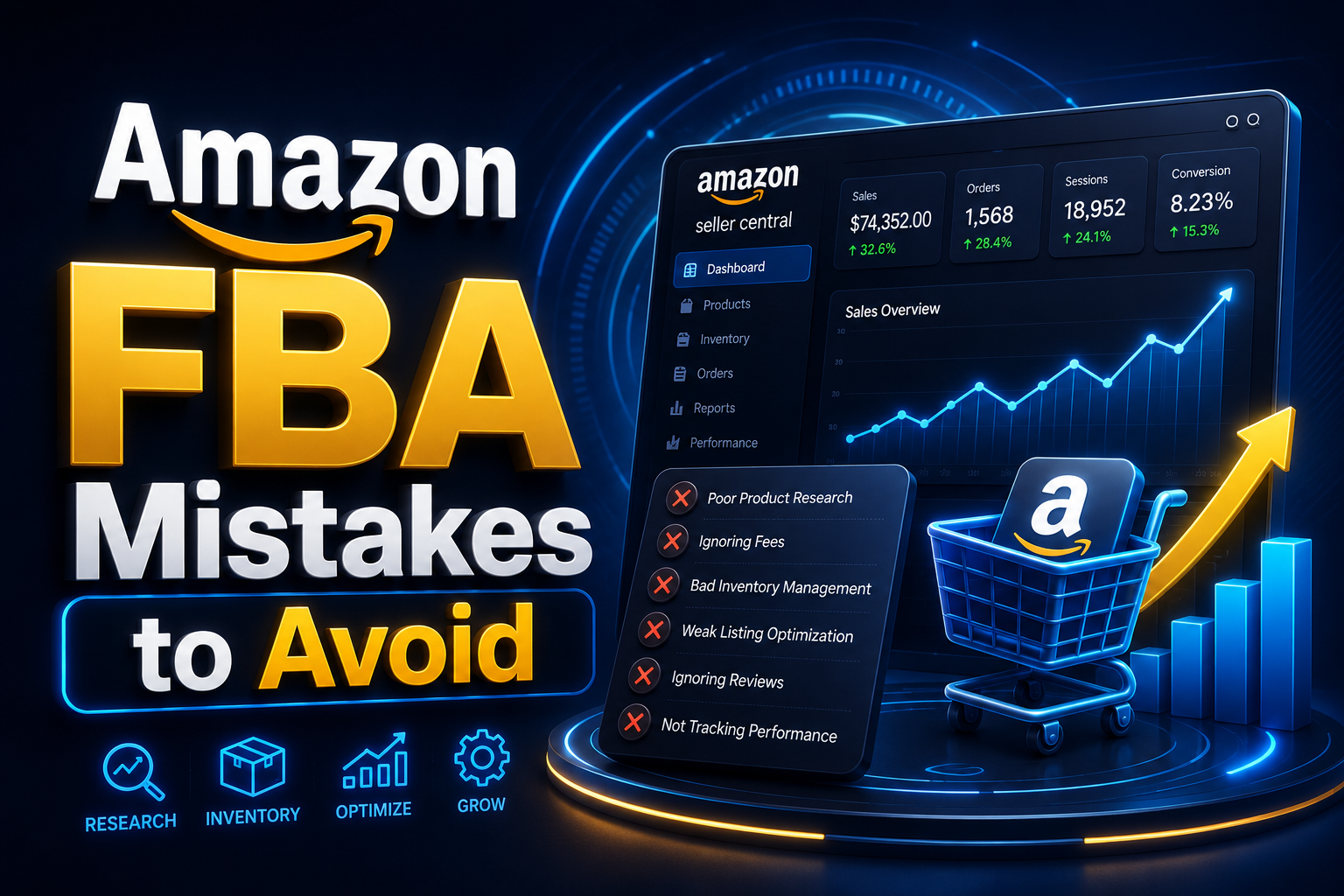
These are the critical Amazon FBA mistakes to avoid if you want to protect your margins and build something that actually scales. Amazon FBA sellers don’t lose money in one big moment. They lose it slowly on a wasted ad budget here, a stockout, a listing that never converts.
By the time the numbers don’t add up, the damage is already done. After managing FBA accounts across multiple categories and marketplaces, we’ve seen the same patterns repeat. These are the Amazon FBA mistakes to avoid if you want to protect your margins and build something that actually scales.
Mistake 1: Choosing a Product Based on What Looks Good, Not What the Data Says
This is where most sellers lose before a single unit ships.
The typical pattern: a seller finds a product with strong BSR, lots of reviews, and a price point that looks healthy. They launch. Then they spend three months trying to compete with sellers who have 2,000 reviews, established supply chains, and ad budgets that dwarf theirs.
What the data actually needs to show before you commit:
- Consistent monthly search volume is not a trend spike
- Fewer than 100 reviews on the top three listings (ideally under 50)
- A price point above $25 to absorb FBA fees without destroying margin
- At least one clear weakness in existing listings you can fix
Product validation is the foundation on which everything else is built. If this step is wrong, no amount of PPC spend or listing optimization recovers it. Our Amazon account management always starts with a product audit for exactly this reason.
Mistake 2: Treating Your Listing as a One-Time Setup
Your listing is not a form you fill out once. It’s a conversion asset that needs to be maintained.
We audit listings every month at EcomExpert. The pattern is consistent: sellers who set their listing up at launch and never touch it again see conversion rates decline steadily as competition improves and search behavior shifts.
The specific errors we find most often:
Titles stuffed with keywords but no buyer benefit.
Amazon shoppers decide in under two seconds. If your title reads like a keyword list, they move on.
Bullet points that describe features, not outcomes.
“Made from stainless steel” tells the buyer nothing. “Stays rust-free after 500+ dishwasher cycles” tells them why to buy.
No A+ Content, or A+ Content that looks like a free template.
Listings with strong A+ Content convert 3–10% higher on average. That’s not a small number when you’re running ads.
Main images that meet Amazon’s rules but don’t stop the scroll.
Your main image competes against every other result on that search page. If it doesn’t stand out in a thumbnail, nothing else matters.
A properly structured Amazon listing optimization, title, bullets, backend search terms, and A+ Content working together regularly lifts conversion rate without increasing ad spend. That’s money already in your funnel that you’re currently leaving behind.
Mistake 3: The Amazon FBA Mistakes to avoid in your PPC campaigns
Unstructured PPC is one of the most expensive Amazon FBA mistakes to avoid, and also one of the most common.
The typical approach is to launch one automatic campaign, set a daily budget, check it two weeks later when ACOS is sitting at 55%, then either scale it anyway or turn it off. Neither is the right move.
A structured PPC setup that actually works:
- Auto campaigns run at low bids with a limited budget that exist only to collect search term data, not to drive main sales volume.
- Broad match campaigns test which search terms from your auto data actually convert.
- Exact match campaigns only contain proven, converting terms — this is where you scale budget.
- Negative keywords get reviewed and added weekly. Not monthly. Weekly.
Without this flow, you’re essentially paying Amazon to show you data you never act on.
We target sub-15% ACOS on established products in our Amazon PPC management service. New launches run higher but with a structure that brings it down systematically as real data comes in. That’s the difference between a strategy and a guess.
Mistake 4: Stockouts — The Rankings Killer Nobody Talks About Enough
Running out of stock is not just an inventory problem. It’s a rankings problem that costs you twice: once when you lose the sales, and again when you spend money rebuilding the organic rank you already paid to establish.
When your listing goes out of stock, Amazon stops showing it organically. Your velocity signals drop. Your ad history partially resets. When you come back in stock, you’re effectively relaunching — spending ad budget to recover ground you already covered.
On the other side, overstocking is equally damaging. Amazon increased long-term storage fees in 2025, Amazon FBA fee schedule and a low IPI score (below 400) restricts your future storage allocation. Sellers who consistently overstock get caught in a cycle of high fees and limited capacity exactly when they need to scale.
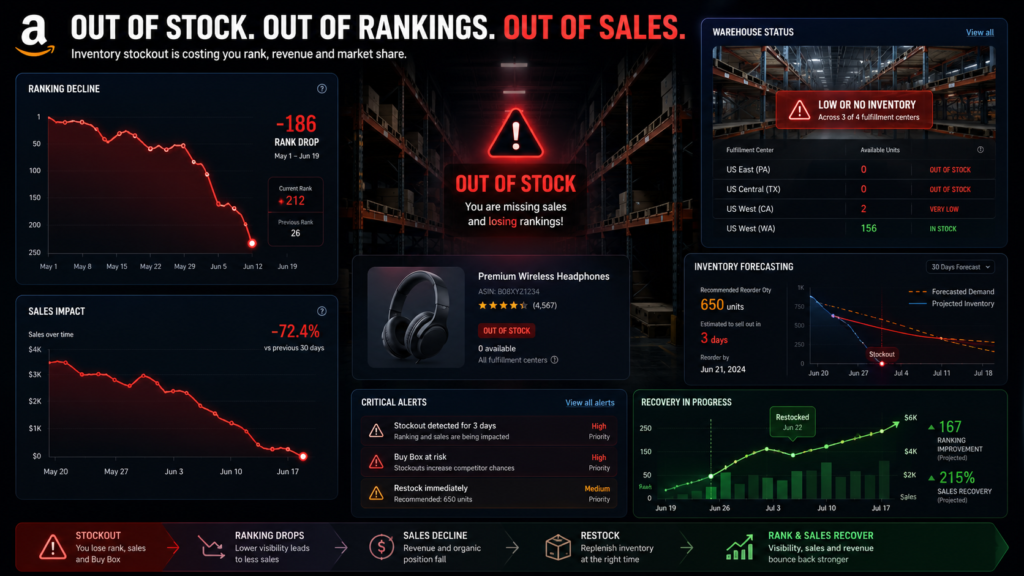
The fix is demand forecasting using actual sell-through rate data, seasonal adjustments, and supplier lead times — not gut feeling. Sellers who do this consistently don’t run out of stock. It’s not talent. It’s a system.
Mistake 5: Tracking Revenue Instead of Profit
This one quietly destroys sellers who think their business is working.
A seller doing $60,000 per month in revenue sounds successful. After FBA fees, cost of goods, PPC spend, returns, and storage charges, that same seller might be taking home $3,000 — or less. We’ve audited accounts where the seller was technically losing money at scale.
The numbers you need to track every month not every quarter:
- Net margin per unit (after all fees, not just COGS)
- TACoS — Total Advertising Cost of Sales, which includes organic sales in the denominator. A healthy TACoS for an established product is under 10%. Above 20% means your organic rank isn’t doing enough work.
- Refund rate — anything above 5% signals a product or listing problem
- IPI score — ignore it until Amazon sends you a warning, and it’s already costing you
If you don’t know these numbers right now without checking, that’s the first problem to fix.
The Common Root Cause
Every mistake above traces back to the same thing: operating on assumptions instead of verified data.
The sellers who grow past $50K/month aren’t necessarily more experienced. They have better systems. They run weekly PPC audits. They review listing performance monthly. They know their unit economics before they make any scaling decision.
If your Amazon FBA business is growing slower than it should, or you’re not sure why your ACOS is high, your ranking dropped, or your margins are shrinking — those are diagnostic problems, not bad luck.
That’s the work we do at EcomExpert. We audit accounts, identify exactly where the margin leak is, and fix it with a structured plan — not generic advice.
Book a free Amazon account audit, and we’ll tell you specifically what’s holding your account back and what it would take to fix it.
Frequently Asked Questions
What are the biggest Amazon FBA mistakes to avoid as a new seller?
Poor product selection, unstructured PPC, and weak listing optimization are the three fastest ways to lose money early. Fix product validation first everything else builds on it. These are the biggest Amazon FBA mistakes to avoid as a new seller.
How do I know if my Amazon PPC is actually working?
Track TACoS, not just ACOS. If your TACoS is above 15% on a product that’s been live for more than 90 days, your organic ranking isn’t strong enough, and your campaign structure likely needs a rebuild.
What is a healthy ACOS on Amazon?
It depends on your margin, but for most private label products, target 15–25% ACOS during launch and push toward sub-15% once the product is established. If you’re above 30% after 60 days, something in the structure is wrong.
How do stockouts affect Amazon rankings?
They drop your organic ranking because Amazon’s algorithm rewards velocity. When velocity stops, ranking falls. Rebuilding it costs ad spend — sometimes more than you saved by running lean on inventory.
When should I hire an Amazon agency?
When the cost of doing it yourself in time, wasted ad spend, and missed rank. It exceeds the cost of getting it right the first time. Most sellers wait too long.